Type “sakura” into a Japanese font generator and out comes サクラ — real Japanese characters you can paste anywhere text goes. Type the same word into a Korean one and you get ㅅㅏㅋㅜㄹㅏ — something that looks Korean but isn't. Both are called “font generators,” and neither is a font or a translation.
This guide separates the four different things sold under that one label, explains exactly what each engine does to your letters, answers the question almost every competitor dodges — can a Japanese or Korean speaker actually read it? — and maps where each style survives, from Instagram bios to game name fields.
Four different things are called a “Japanese font generator”
Search for a Japanese or Korean font generator and you land on pages doing completely different jobs. Picking the right kind first saves more time than comparing features:
The fourth kind exists because “fake Japanese text” has a second meaning: designers use Japanese-looking placeholder text (like Lorem Ipsum), and writers invent fake brand names that merely look Japanese. Those tools generate words; the first kind transforms your own. Everything below is about the first kind — the one that produces copy-paste text.
| What you actually want | What the page gives you | Example output |
|---|---|---|
| Styled text for bios, names and chats | A Unicode character swap — what this guide covers | サクラ, sakura, ㅅㅏㅋㅜㄹㅏ |
| A real Japanese typeface for design work | A font file (TTF/OTF) to install | An image rendered in a brush or mincho font |
| Text as a picture | A rendered PNG/SVG export | A downloadable image — works where styled text can't be typed |
| Invented Japanese-sounding words | A random word generator | Made-up names for anime brands or game characters |
What the katakana engine actually does
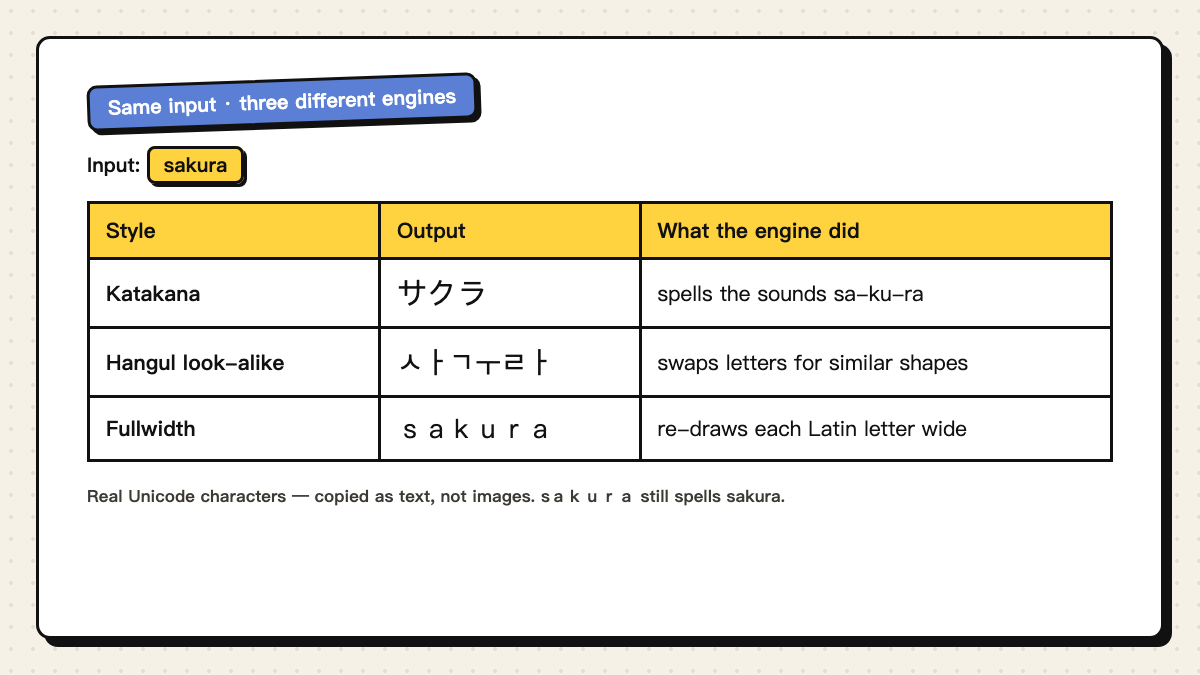
The Japanese-style row on our Japanese font generator runs a romaji-to-katakana chart. It reads your word as syllables and spells each one with a real katakana character: sa-ku-ra becomes サクラ, hello becomes ヘルロ. Doubled consonants get the small ッ — sakka becomes サッカ — the same rule written Japanese itself uses for foreign loanwords like スカンク (skunk).
Two boundaries follow from the mechanism. First, it is transliteration, not translation: サクラ spells the sound “sakura,” but typing “hello” gives ヘルロ, a Japanese-readable spelling of an English word — the meaning is still yours, not Japan's. Second, letters with no Japanese sound pass through unchanged: q and x have no katakana syllable of their own, so they stay Latin.
What the Korean engine actually does — and why it's different
The Korean-style row works nothing like the Japanese one. Instead of spelling sounds, it swaps each Latin letter for a Hangul letter of similar shape: s→ㅅ, a→ㅏ, r→ㄹ, so sarang comes out ㅅㅏㄹㅏㄴㄱ. That string is assembled from real Korean letters (jamo), but it is not a Korean word — a Korean speaker sees loose letters, not 사랑, the actual word for love.
This shape-based swap is honest decoration: nobody can misread it as real Korean, because it isn't readable as Korean at all. If you want your name spelled so a Korean speaker can pronounce it, you need a real transliteration — 사랑 is the spelling of “sarang,” and it comes from Korean spelling rules, not a font generator. Our Korean font generator does the shape look-alike and says so plainly; treat anything claiming to “translate” a name into Korean with suspicion.
Can Japanese and Korean speakers actually read it?
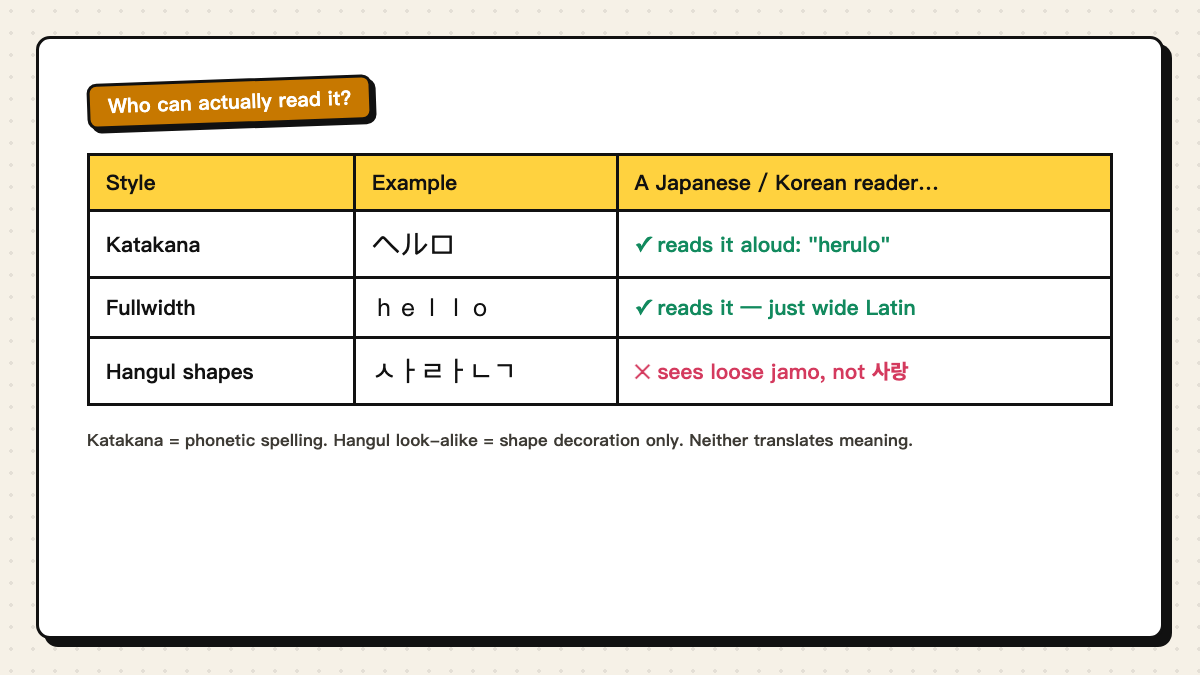
Katakana: yes. A Japanese reader sounds out サクラ as “sakura” exactly as intended — that is what katakana is for; Japan uses it daily for foreign names and brands. Your styled name is not secret code, so don't put anything there you wouldn't say out loud.
Fullwidth text — the wide aesthetic style — is also readable: it is your ordinary Latin letters re-drawn wide, borrowed from the same Unicode region as halfwidth katakana, which is why “aesthetic Japanese” and vaporwave text travel together. Anyone literate in English reads sakura without effort; it just looks like it belongs in a Japanese setting.
Hangul look-alikes: no — and that is by construction. ㅅㅏㄹㅏㄴㄱ is a letter-shape costume, not Korean. If readability matters, the only honest route is real spelling in the real script.
Where each style actually works
Because all three styles are plain Unicode, the rules are the ones that govern every fancy text style: display names and bios take them, @handles and search fields don't. The Japanese-family styles have one extra advantage — kana glyphs ship on virtually every phone and computer, so they are among the least likely styled text to arrive as boxes □. The detailed per-platform rules live in the name-length limits guide; the short version:
One caveat deserves spelling out before the table: game name fields run on anti-impersonation whitelists that only accept characters the game's own font pack knows, and many refuse kana outright with an “invalid characters” error. That refusal is a save-block, not a ban — test in the actual name field before committing anything permanent.
| Field | Katakana | Fullwidth | Hangul shapes |
|---|---|---|---|
| Instagram / TikTok display name | Works | Works | Works |
| Instagram / TikTok @handle | Refused — plain letters only | Refused | Refused |
| Discord nickname & server name | Works | Works | Works |
| WhatsApp / Telegram profile name | Works | Works | Works |
| Most shooter & mobile game name fields | Often refused — whitelist | Mixed | Mixed |
| Search, mentions, hashtags | Mismatch — keep plain spelling somewhere | Same | Same |
The awkward asks, answered honestly
- Vertical Japanese text: real Japanese is traditionally written top-to-bottom, and you can imitate it with one character per line in a bio or multi-line caption. No generator produces “vertical Unicode” — vertical is layout, not characters. (The autocomplete demand for “japanese font generator vertical” is real, but the honest answer is line breaks.)
- PNG / image export: some sites render your text into a picture. We don't export images — a picture can't be pasted as a name or bio text anyway. If you need an image (video thumbnail, logo mock), screenshot the rendered text or print-to-PDF from the browser.
- Tattoos: do not tattoo generator output. Katakana transliteration is at least phonetically honest, but a permanent mark deserves a real translation checked by a native speaker — generator pages, including ours, are decoration tools.
- Does Japanese have spaces? No — written Japanese normally has none, since kanji and kana boundaries make words self-separating. That's why there is no “spaced Japanese” style, and why fullwidth Latin (which does keep letter boundaries) is the practical stand-in for the aesthetic.
- What does this Japanese writing say? If you received styled katakana and want it back in Latin, reverse the sound: read each character from the chart and type what you hear — サクラ is sa-ku-ra. Fullwidth text needs no decoding at all; Hangul look-alikes decode letter-by-letter through the same shape map that made them.